Case Study 02 · Spring 2024
Building a Reliable Assessment Workflow
Level B assessment training · Standardized administration · Observation · Educational planning
Context
As part of MEDS 610: Assessment, Intervention, and Planning, I completed graduate training in standardized academic assessment, including repeated practice administering KTEA-3 subtests.
The work required a different kind of attention than most classroom activity. Administration had to remain consistent. Directions, timing, start and stop rules, response recording, examiner behaviour, and scoring procedures all mattered.
At the same time, the student still needed my attention.
The challenge was not simply knowing the procedure. It was being able to follow it accurately while remaining present enough to observe the learner in front of me.
The problem
During early practice, I noticed how much working memory standardized assessment demands from the examiner.
I needed to track procedural details, manage materials, record responses, monitor timing, maintain neutral feedback, and notice behaviour that might be useful later in interpretation.
I did not want the mechanics of administration to consume all of my attention.
So I built a tool to help.
The artifact
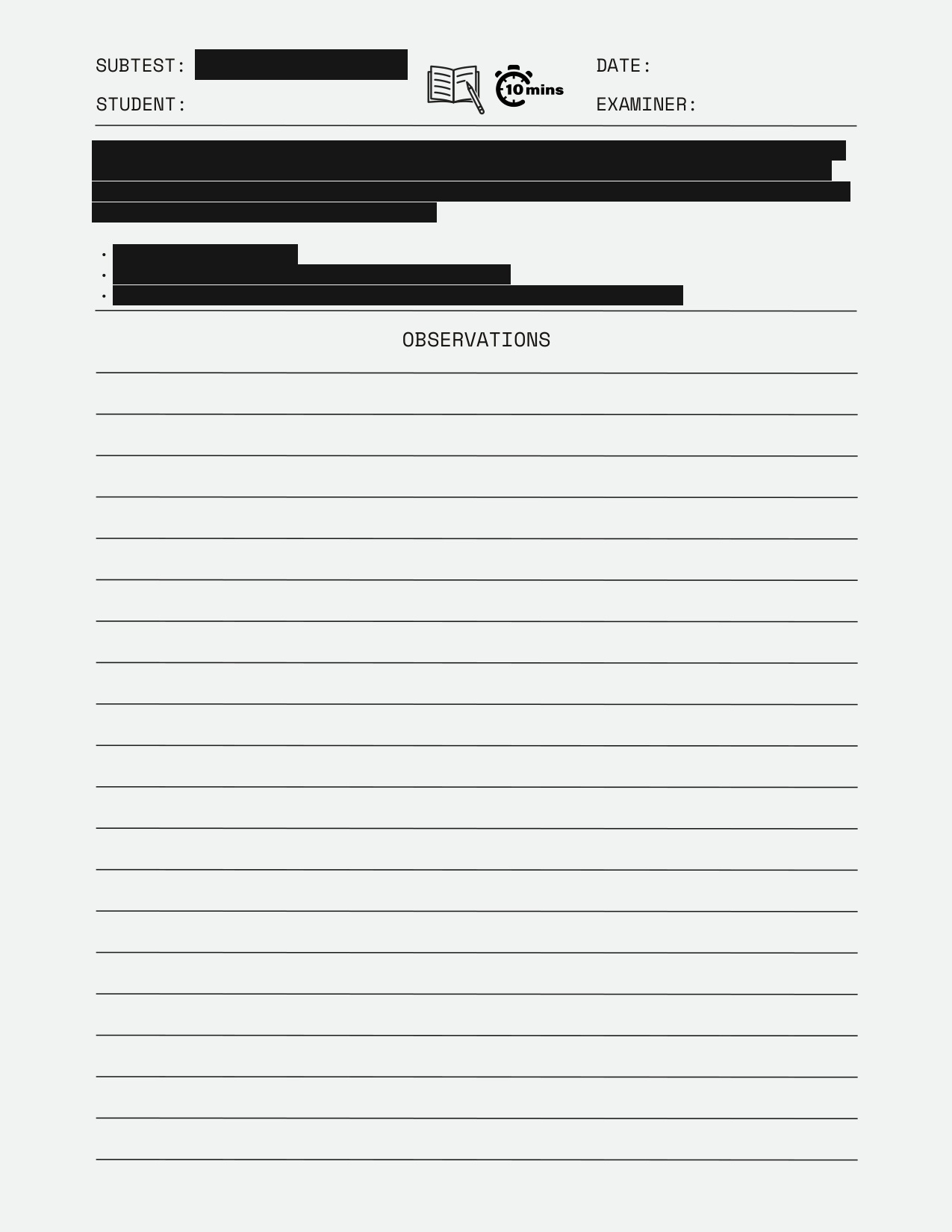
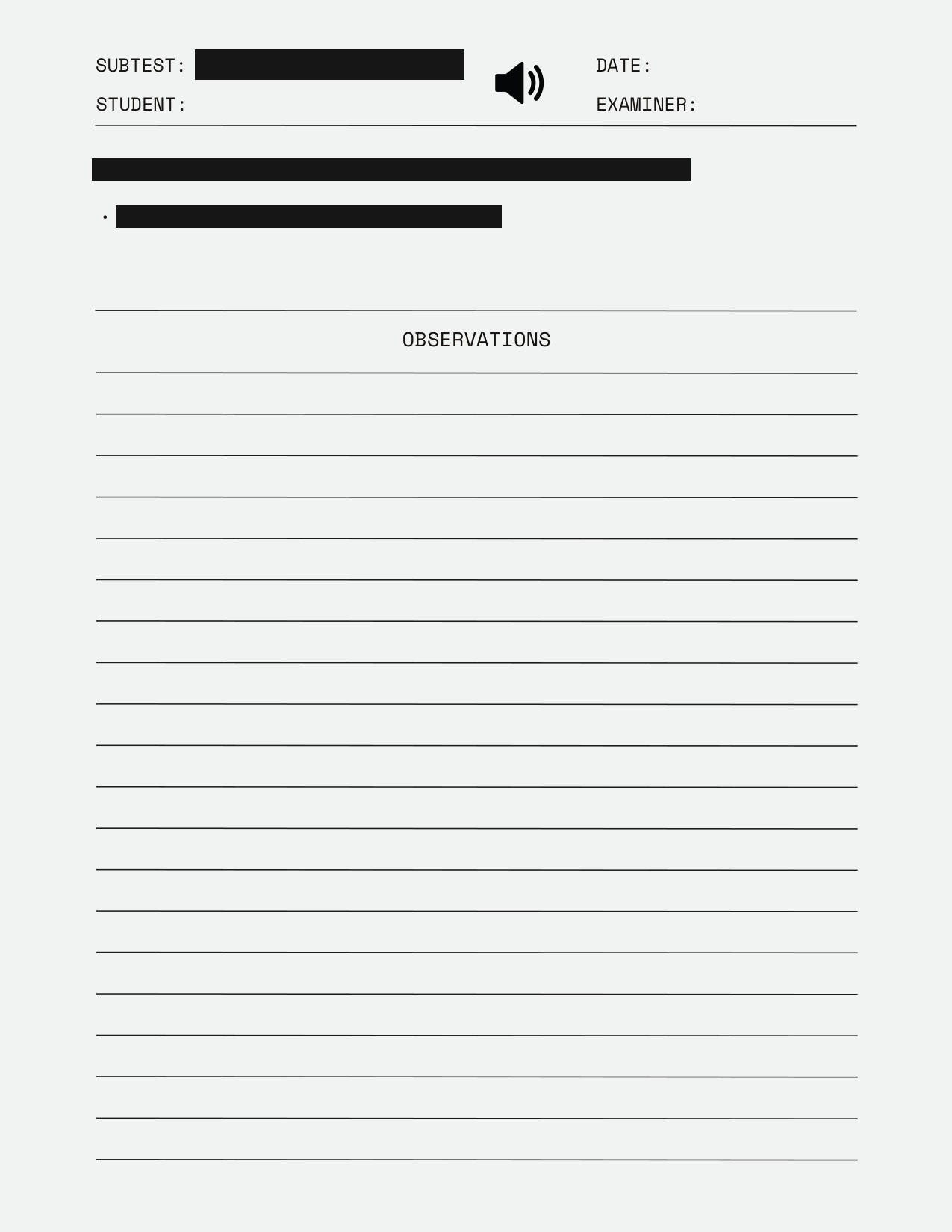
I created a ten-page examiner administration pack, with a separate working page for each KTEA-3 subtest I was practising.
Each page gave me a consistent place for identifying information, essential reminders, materials or preparation notes, and real-time observations.
For more procedurally demanding subtests, I added practical prompts about things I was most likely to need in the moment: having the correct response materials ready, remembering timing requirements, marking start and stop points, attending to discontinue rules, or pre-loading audio before the session began.
The point was not to change the standardized procedure. It was to make my own preparation more reliable so that I could follow the procedure with less avoidable cognitive load.
Inside the work
An examiner pack built for reliable preparation
The ten-page pack used a consistent structure while preserving the distinct memory cues and preparation needs of each subtest.
The design question
How can I organize myself well enough to administer it faithfully and still notice the student?
What changed
The pack gave the administration process a predictable structure.
Instead of holding every practical detail in my head at once, I could prepare materials in advance, keep key reminders visible, and use the page in front of me to capture observations without continually shifting attention between separate notes.
That mattered because standardized assessment asks the examiner to do two things at once: preserve the integrity of the procedure and attend closely to the learner.
My later practicum reflection noted that advance preparation contributed to smoother transitions during testing and created better space for information that could support scoring afterward.
Working within a standardized process
This project reinforced an important distinction for me.
Some educational situations invite improvisation. Standardized assessment does not.
Validity depends on following established administration procedures closely. During the course, I became increasingly aware of basal and ceiling rules, neutral examiner behaviour, accurate response recording, behavioural observation, scoring, and interpretation.
The useful design problem was therefore not, How can I improve the assessment?
That distinction has stayed with me.
What this demonstrates
- 01Graduate training in Level B academic assessment
- 02Repeated practice with standardized KTEA-3 administration
- 03Careful attention to procedural fidelity and examiner neutrality
- 04Designing practical systems to reduce avoidable cognitive load
- 05Real-time behavioural observation and documentation
- 06Connecting assessment information with interpretation, intervention, and educational planning
- 07Working accurately within a formal process without losing sight of the learner
Reflection
Standardized assessment did feel rigid at first, but repeated practice helped me understand why that structure matters. When procedures are clear and preparation is thorough, I am not trying to invent the process while sitting with a student. I can follow it accurately and still notice how the learner is approaching the work.
That is where the examiner pack became useful. Keeping practical reminders in one place made it easier to pay attention to persistence, hesitation, self-correction, patterns in responses, fatigue, and the ways a student approached unfamiliar tasks. It also gave me a reliable place to capture observations I would need later, when scoring and writing them up more formally.
I became increasingly interested in what happens after a score is produced. Assessment information matters when it helps educators recognize strengths, identify areas that may need support, and make better-informed decisions about intervention and educational planning.
The pack began as a practical way to keep myself organized during administration. In the end, it showed me how a well-designed system can carry some of the procedural load and leave the examiner better able to attend to the student.